
Seed, mulch and soil prep below sea level
Hydroseeding in New Orleans, LA
New lawns, construction cover and erosion control for clay, fill and heavy Gulf rain.
- We walk your lot at no charge, then send the quote in writing
- Grading, topsoil, seed and erosion controls priced as separate lines
- 811 utility locates requested before we grade or dig
Growing Grass on River-Built Ground
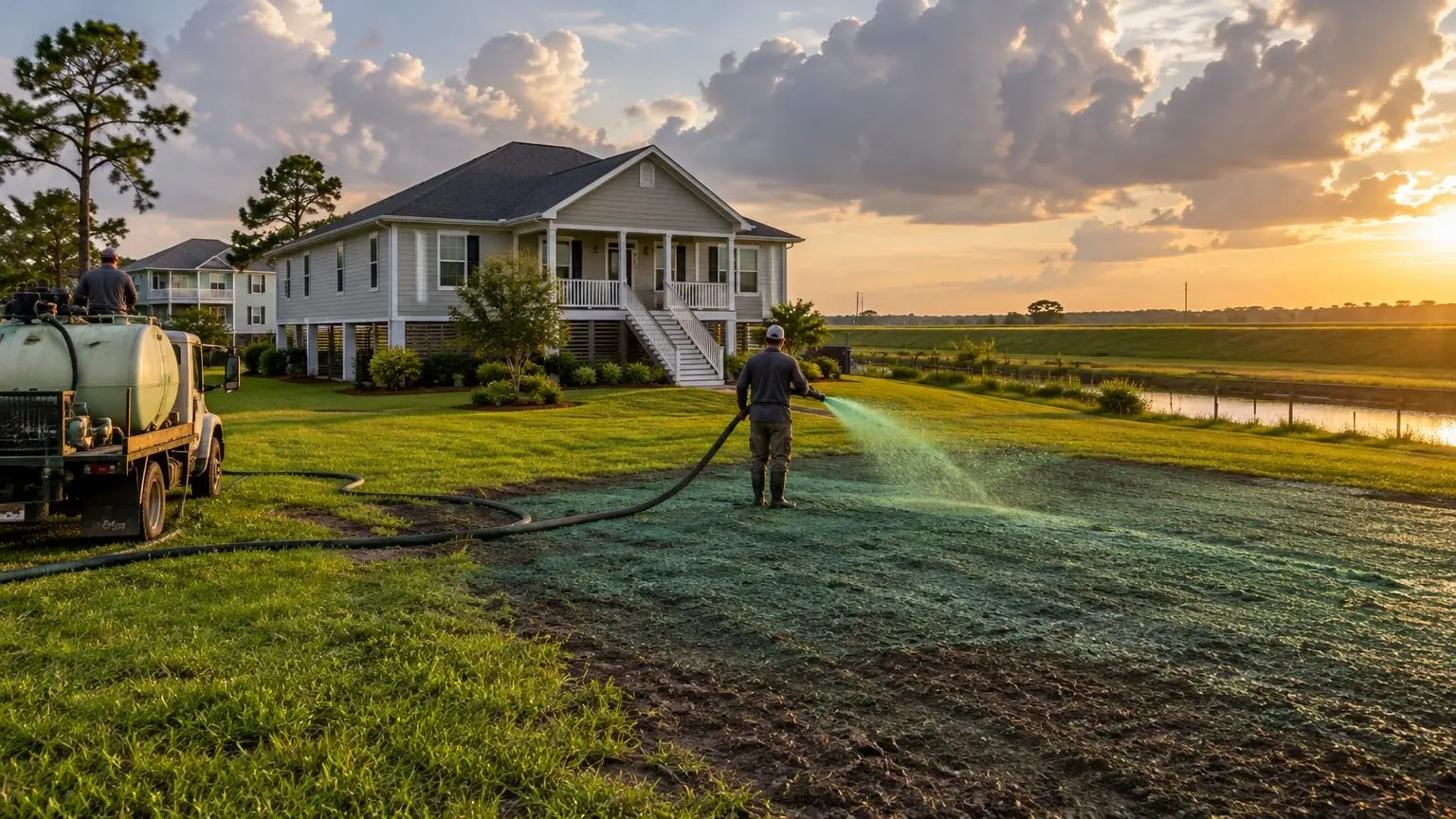
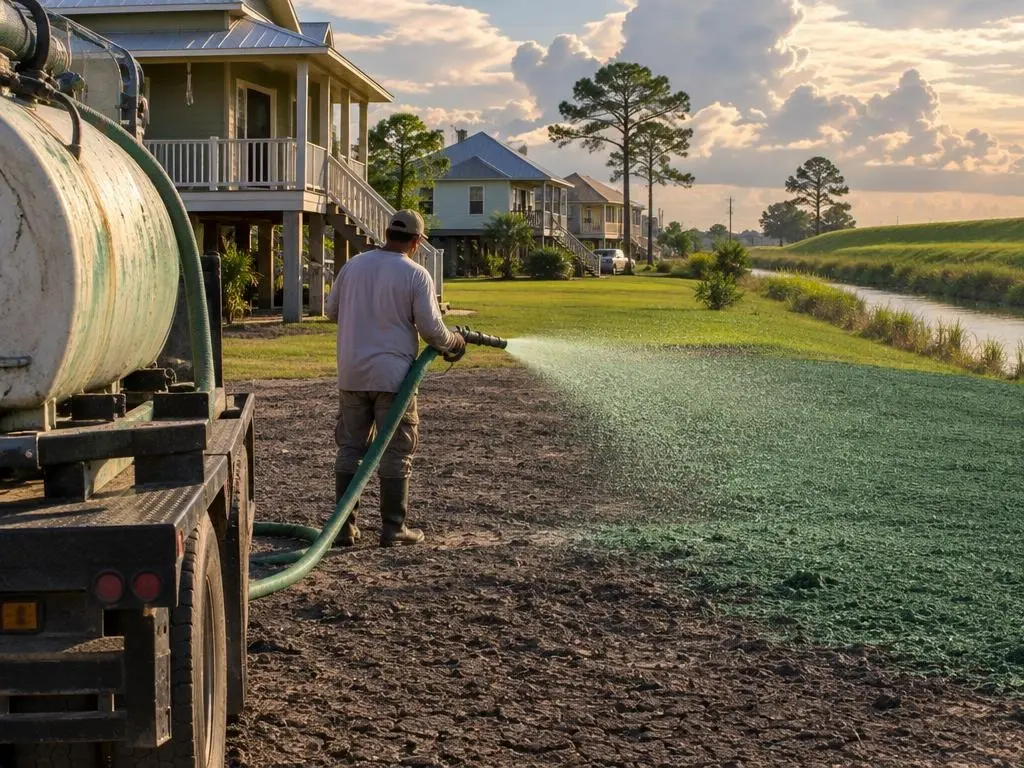
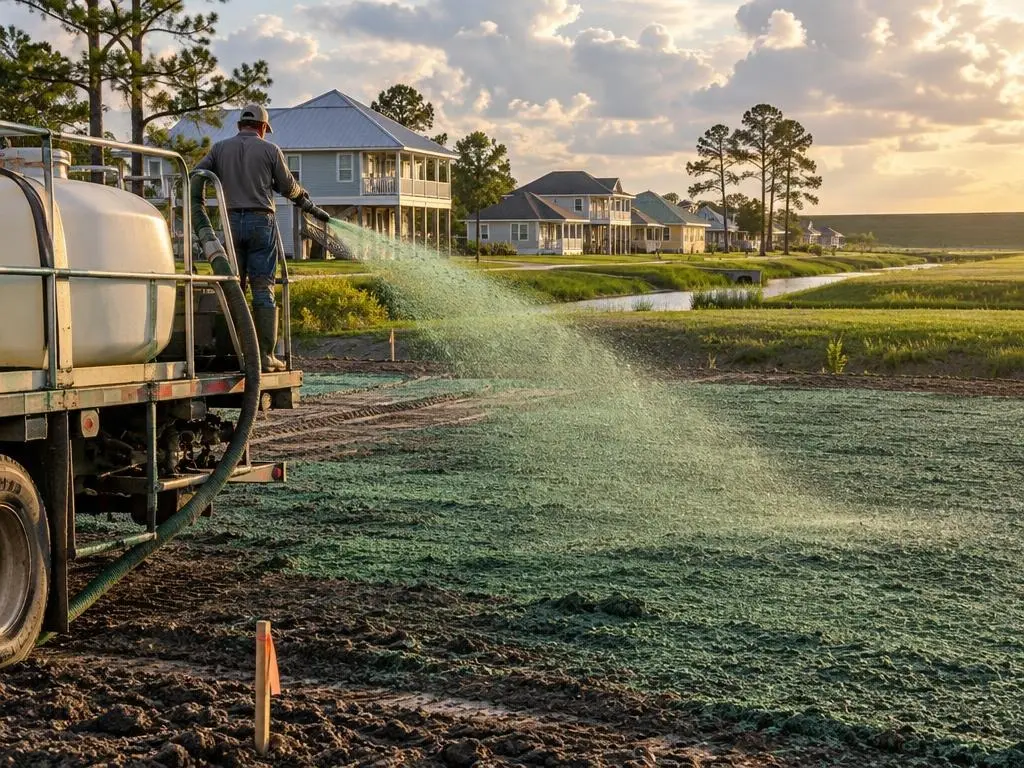
Hydroseeding in New Orleans means growing grass on ground the river built, the pumps keep dry and the Gulf soaks with more than 60 inches of rain a year. Our tank mix carries grass seed, fertilizer, tackifier and shredded wood fiber, and the hose lays it over prepared soil so each square foot gets seed and a protective cover in one pass. Our crews hydroseed new lawns behind raised and rebuilt houses, bare yards after drainage or foundation work, builder lots, detention areas and the ditches and swales that carry water toward the canals. We also grade, bring in topsoil, set silt fence and lay erosion control blankets, so a single crew can take a site from bare dirt to stable cover.
Levee ground and backswamp clay
The city was first settled on the Mississippi's natural levees, the slightly higher ground along the river, and only spread into former marsh and swamp once pumping made the low ground usable. Its average elevation is now 1 to 2 feet below sea level, and the land along the river is a pattern of ridges and hollows. Two USDA soil series describe the two kinds of ground found on this part of the Mississippi floodplain. Commerce soils sit on natural levee positions: loamy, somewhat poorly drained, and long farmed in sugarcane in south Louisiana. Sharkey soils fill backswamps and abandoned channels: 60 to 90 percent clay below the surface, very slowly permeable, and prone to cracks 1 to 3 centimeters wide that run 20 inches or deeper in most years. The USDA's lab records for Sharkey include a sample taken in Jefferson Parish. A lot near the river and a lot that was once backswamp can need very different prep.
What clay and fill mean for seed
On heavy clay, rain sits on top instead of soaking in, and the surface seals and crusts after a hard storm. Seed scattered dry on that kind of ground tends to wash into the low spots or dry out on the crust. Hydromulch helps on both counts: the wood fiber keeps each seed in a damp jacket, and the glue in the mix stops it from floating off in the first downpour. It does not fix grade. Where a yard was built up with fill after a flood or a house raising, we look for soft or settled areas and dips that hold water before anything is sprayed. On clay that cracks in dry spells, we loosen the surface and add topsoil where the existing soil is too dense to root into.
Rain, heat and the seeding calendar
The 1991 to 2020 normals for Louis Armstrong New Orleans International Airport average 63.35 inches of precipitation a year, spread over about 115 days. June is the wettest month at 7.62 inches, and October is the driest at 3.70. Bermudagrass, one of the warm-season lawn grasses that grows from seed, starts actively growing above about 59 degrees and grows fastest between 75 and 99. The airport's daily mean temperature passes 70 degrees in April and stays above it through October. Angi describes late spring through mid-summer as the usual window for warm-season seed. Here that means April into early fall works for most seeded lawns, with two cautions: summer cloudbursts can scour an unprotected surface, and a lawn seeded in late fall has little growing weather left before winter. Winters are short, with fewer than 8 nights of freezing lows in a typical year, but a dormant lawn still adds little cover until spring.
Sod, hydroseed or dry seed
St. Augustine is popular across subtropical regions, and it changes the math here: it has typically been planted as sod, plugs or sprigs, because commercially viable seed only recently became available. If you want a St. Augustine lawn, we will tell you that sod or plugs are the usual route. Hydroseeding fits grasses that grow from seed, such as bermudagrass, and it fits large areas, slopes, swales and construction sites where cost and erosion matter more than an instant lawn. Cost guides line the three methods up the same way. HomeGuide's hydroseeding range runs from $0.12 up to $0.35 a square foot, while it shows sod installation at $1 to $4, and HomeAdvisor puts broadcast dry seed at $0.10 to $0.20. The University of Nebraska Extension sums it up: hydroseeding costs a little more than dry seeding and generally less than sodding. It also comes up faster. That same extension source says hydroseeded grass generally shows in 5 to 7 days, where dry seed tends to take two to three weeks.
Water that has nowhere to go
Because the terrain is low and flat, most rain inside the levees leaves through a system of canals and pumps. The Sewerage and Water Board's pumping capacity is often described as 1 inch of rain in the first hour and half an inch per hour after that. When a cloudburst beats that rate, streets fill. Bare dirt makes it worse twice over: it sheds water faster than turf, and the silt it carries settles in catch basins and drain lines. Federal construction stormwater rules, which every state construction permit must meet at a minimum, call for erosion and sediment controls on disturbed sites, and once work on a disturbed area pauses for more than 14 days, that ground has to be stabilized right away. Permit coverage kicks in at one acre of disturbance, and smaller jobs are pulled in too when they belong to a bigger subdivision or development plan. Silt fence, inlet protection and a quick hydroseed or hydromulch cover are how most sites meet those terms.
City landscape rules
Article 23 of the city's Comprehensive Zoning Ordinance requires a landscape plan for all development except single-family homes, two-family homes and multi-family buildings of six units or fewer. Its stated aims include slowing stormwater runoff and encouraging infiltration to reduce subsidence, and it calls for at least half of required landscaped areas to be built as green stormwater infrastructure. On commercial and multi-family work, our seeding follows the approved landscape plan, including grassed detention areas and swales. For homeowners, the city's NOLA Ready green infrastructure guide lists rain gardens and detention basins as ways to hold rainwater on a lot. Turf-lined basins need regrading of eroded spots and reseeding from time to time, and that is work we do.
How a job goes
- A site visit to check grade, soil, shade, drainage and access
- A written estimate that separates grading, topsoil, seed, mulch and erosion controls
- 811 utility locates before any digging or grading
- Soil prep: debris out, ruts and low spots fixed, topsoil where it is needed
- A seed mix matched to sun, shade and season, sprayed with mulch and tackifier
- Watering instructions for the first weeks and a check on germination
Why Homeowners Call Hydroseeding New Orleans
Prep comes first
We fix grade, settled fill and dense clay before spraying, because mulch cannot fix a low spot.
Straight talk on grass type
If the grass you want is normally sodded, like St. Augustine, we say so and price the right method.
Erosion control in-house
Silt fence, inlet protection, blankets and grading come from the same crew that seeds.
Itemized written estimates
Grading, topsoil, seed and mulch, and erosion controls each get their own line.
Common Questions
What is the average cost of hydroseeding per square foot?
It depends on whose guide you read: HomeGuide's range is $0.12 up to $0.35 a square foot, Angi's $0.07 to $0.26 and HomeAdvisor's $0.06 to $0.20. Many hydroseeding companies also charge a floor for small jobs; LawnStarter's figure for that minimum is $300 to $500. Grading, topsoil and slopes add to the total, and once you accept our written proposal, that number stays put.
Is lawn hydroseeding expensive compared with sod?
Usually not. In HomeGuide's numbers, laying sod runs $1 to $4 a square foot, several times the cost of hydroseed. The trade-off is time: sod is a lawn on day one, while hydroseed needs about 4 to 6 weeks before the first mow.
Which grass seed works for South Louisiana lawns?
Bermudagrass grows from seed, forms a dense mat and recovers quickly from wear, so it is the usual choice for a seeded lawn. St. Augustine has typically been planted as sod or plugs, and centipedegrass is lower maintenance with medium shade tolerance but shallow roots. We match the grass to your sun, shade and use.
Which months give New Orleans hydroseed the strongest start?
For warm-season grass, April into early fall. The airport's daily mean temperature stays above 70 degrees from April through October, which keeps warm-season seed growing. Late-fall seedings have little time to establish before winter.
How soon will I see grass after hydroseeding?
With warm soil and steady moisture, HomeGuide says germination can begin in 5 to 7 days, and Angi says sprouts on most hydroseeded lawns appear somewhere in the 7 to 14 day window. Keep the mulch damp the whole time. Thin spots usually show by the third or fourth week and can be touched up.
How often should I water new hydroseed?
Light and often. The University of Nebraska Extension calls for a minimum of two to three light waterings daily during hot spells, and Iowa State Extension says light watering should continue for about three weeks. A soaking thunderstorm can count for a day; a dry, hot spell cannot be skipped.
Can a construction site be hydroseeded outside the growing season?
Yes. Even when grass grows slowly, hydromulch with tackifier covers bare soil right away, and federal construction rules require disturbed areas to be stabilized when work stops for more than 14 days. We adjust the seed mix to the season and come back to touch up as it warms.
Do I need silt fence for work on my house lot?
Federal construction stormwater permits start at one acre of disturbed ground, and smaller jobs count when they are part of a bigger development plan. Many single lots fall below that, but builders and the city can still require sediment controls. We can tell you what is typical and set silt fence and inlet protection either way.
From the River Parishes to the North Shore
We work in Orleans, Jefferson, St. Bernard, Plaquemines, St. Charles, St. John the Baptist and St. Tammany parishes. On the east bank that means New Orleans, Metairie, Kenner, Harahan and River Ridge, and downriver in Arabi and Chalmette, where many lots were rebuilt after storm flooding. Across the river we cover Gretna, Terrytown, Harvey, Marrero, Westwego and Belle Chasse, with their canals, bayous and wetland edges. Upriver, Destrehan, Luling and LaPlace sit close to the Bonnet Carre Spillway. On the north shore we seed in Slidell, Mandeville, Covington, Madisonville, Abita Springs and Pearl River, where many people moved for larger lots and new subdivisions keep adding bare ground. Pick your town below to read about its own soil, drainage and seeding quirks.
- Hydroseeding in New Orleans, LA
- Hydroseeding in Metairie, LA
- Hydroseeding in Kenner, LA
- Hydroseeding in Harahan, LA
- Hydroseeding in River Ridge, LA
- Hydroseeding in Gretna, LA
- Hydroseeding in Harvey, LA
- Hydroseeding in Marrero, LA
- Hydroseeding in Westwego, LA
- Hydroseeding in Terrytown, LA
- Hydroseeding in Belle Chasse, LA
- Hydroseeding in Chalmette, LA
- Hydroseeding in Arabi, LA
- Hydroseeding in Destrehan, LA
- Hydroseeding in Luling, LA
- Hydroseeding in LaPlace, LA
- Hydroseeding in Slidell, LA
- Hydroseeding in Mandeville, LA
- Hydroseeding in Covington, LA
- Hydroseeding in Madisonville, LA
- Hydroseeding in Abita Springs, LA
- Hydroseeding in Pearl River, LA
Our Services
Six kinds of work, from a single back yard to a builder's whole subdivision phase.
Hydroseed Lawns
New lawn installation by hydroseed for bare yards after raising, rebuilding or drainage work.
Learn more →Construction Site Hydroseeding
Temporary and final cover for builder lots, commercial pads, detention areas and right-of-way.
Learn more →Erosion Control & Hydromulch
Hydromulch, straw and coir blankets and slope stabilization for banks, ditches and swales.
Learn more →Silt Fence & Inlet Protection
Silt fence, catch basin protection and sediment control for house lots and commercial sites.
Learn more →Yard Grading & Topsoil
Dirt work, yard grading, fill and topsoil, plus trenching for drains before seeding.
Learn more →Lawn Repair & Reseeding
Lawn renovation, bare-spot repair and overseeding for thin, flooded or worn yards.
Learn more →Book a Free Walk-Through of Your Lot
We look at grade, soil and drainage, then send a written estimate. Call (504) 285-5966.